The past few months have not gone as I expected.
As many of you already know, I have had to delay the release of Why the Curlew Cries. The novel itself is complete, but the final polishing has taken longer than planned because life demanded my attention elsewhere.
Through all of that, my ARC readers and subscribers have continued to support me. You signed up to read this book, waited patiently for updates and offered kindness when I needed it most. I do not take that patience for granted.
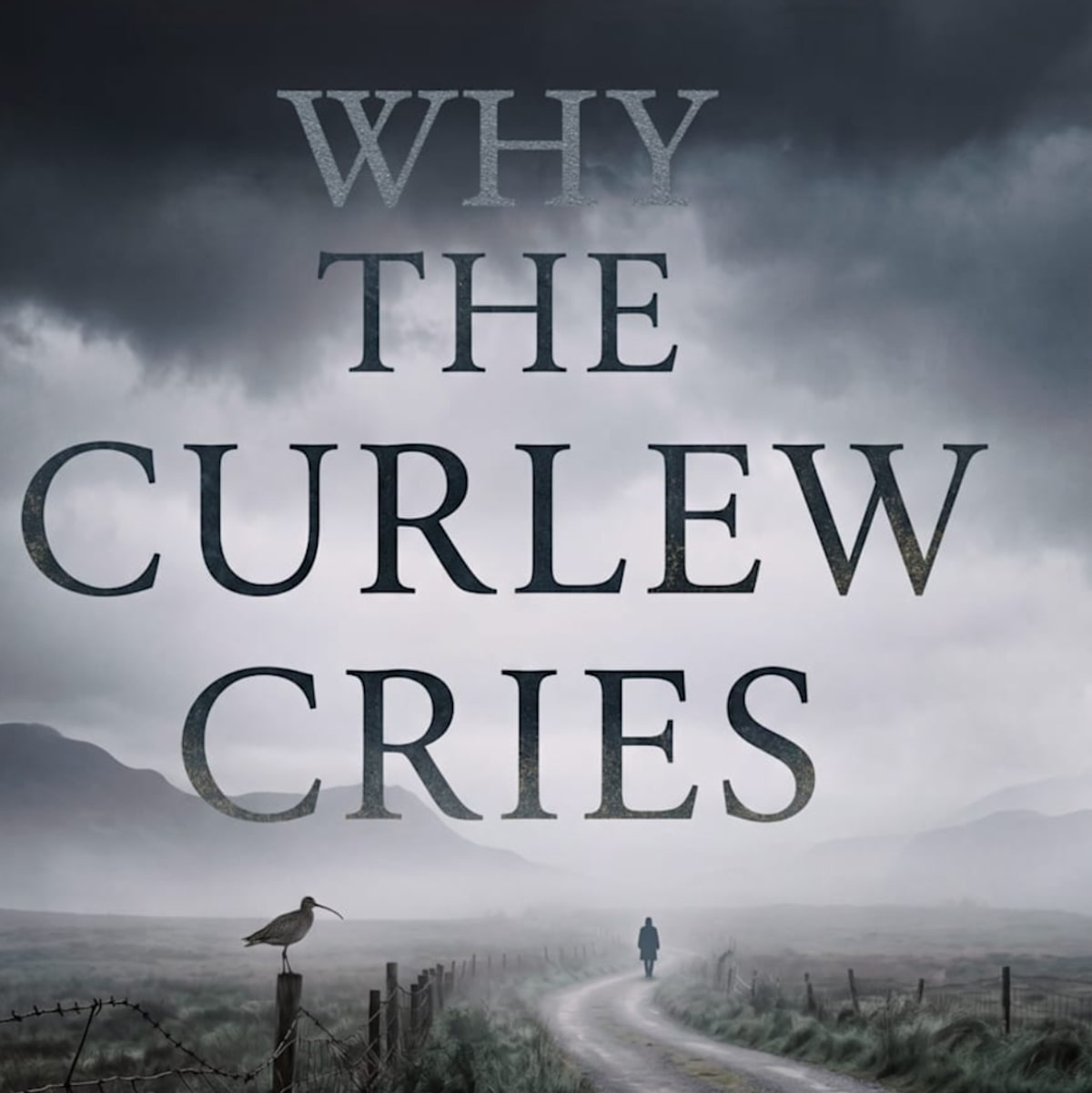
So, as a small thank-you, I am sharing the complete first chapter of Why the Curlew Cries with you today.
This chapter introduces Jack Dawson, a former Garda living alone beneath the Ox Mountains, carrying injuries that never properly healed and memories that refuse to remain buried. When his old partner arrives with a question about a missing woman, Jack is drawn towards a case that will lead him into the most isolated corners of rural Sligo—and towards a secret someone has worked very hard to conceal.
The book is still in its final polishing stage. I want it to be as strong as I can possibly make it before I place it in your hands. It is coming, and I believe the finished story will be worth the wait.
For now, I hope you enjoy this first glimpse into Jack Dawson’s world.
Thank you for waiting.
Thank you for reading.
And thank you for continuing to follow the curlew’s cry.
Read Chapter One below
Chapter One — Unit C, Ballygowel
The village of Ballygowel was quiet most nights, it was a soft kind of quiet, the sort that made violence seem impossible, though it lived there all the same, behind curtains and the things people agreed not to see. Little happened on Ballygowels old roads except when the occasional sheep got loose and farmers swore it wasn’t their fault, when a car had hit one of their animals and it was time to ring the insurance company. Nothing seemed to happen that travelled far enough to make the news.
Ballygowel Garda Station was a small station in North Mayo, the sort of place people forgot existed and was returned to only for funerals. The station consisted of two worn out desks, an overused kettle that boiled slowly, as if as tired of the work as the Garda were. Beside the hatch, a noticeboard sagged with bulletins and missing women’s posters, their faces fading in plain sight, passed daily by men trained to notice things. The other lads on the unit were already there when Jack came in for his night shift, jackets on, laughing around a phone playing a loud video. When they noticed Jack, the laughter didn’t stop, it just seemed to change its shape.
“Dawson,” Garda Pa Guilfoyle said, looking at him with the thin smile of a man who had already decided what he thought of him. “You’re early, for once.”
“I am just delighted to be here,” Jack said, hoping for a laugh but only earning a snort. Time keeping, apparently, was a noticeable personality flaw of Jack’s.
Jack signed in and decided to keep his head down. There’s a loud kind of bullying, name calling, shoves, laughs and then there’s the quiet adult kind. The bullying that doesn’t look like anything until you’ve lived inside it for a while. Conversations that stop dead when you enter a room. Questions that go out but return unanswered. Little looks passed around you as if you were an embarrassing stain on the wall.
Jack knew he didn’t fit. The other Guards knew it too, though everyone behaved as if it didn’t matter.
Gerry Doyle was already there and sat slightly apart, filling out a form, his hand moving patient and sure. Gerry glanced up as Jack came in, caught his eye, and gave the smallest roll of his own, just enough to say he knew exactly what Jack had walked into. Gerry was close to retirement, though he never spoke about it like the others did, as if leaving was worth celebrating. He’d been a detective once, before some higher ups decided he was more trouble than he was worth.
Gerry had pushed too hard on a case that everyone else seemed happy to let go cold. That’s how it seemed to work with the police; they didn’t sack you but moved you sideways until you stopped being a problem.
“Tea?” he said, nodding at the kettle.
“If there’s any left.”
“Sure there’s always tea.”
He poured two mugs, no sugar for him and one for Jack. Gerry began to play with the patrol car keys, swinging them in circles on his index finger as they sipped the tea. At the sight of Gerry playing with the car keys the lads on the far side of the room suddenly found reasons to be busy. One checked a drawer, while another suddenly remembered he’d left something suddenly vital to his survival in his car and didn’t come back.
Gerry watched them go, expression unreadable and began to stand “Right, patrol tonight Jack,” he said, not asking.
Jack nodded. “Looks like it's me and you again.”
“Come on so,” Gerry answered as he let out a groan and stood from his chair.
Outside, the rain had become heavier as it settled into itself. It was a good Irish rain that wasn't trying to be dramatic but did seem to enjoy its constant nagging. The patrol car sat under the stark white security light. The patrol car looked official enough in white, yellow and blue, but underneath it was only a 1.6 diesel with ideas above its station. The bosses must have been afraid the guards might actually catch someone if they gave them anything faster. Gerry didn't ask, he just drove, he always drove. Not because he didn’t trust Jack’s driving though that is what Jack thought it was, but because Gerry was getting older and if he didn’t drive he knew he would fall asleep and that embarrassed Gerry.
They rolled out of the yard, past the closed pub and the church, past the row of houses where the same curtains seemed to have hung for decades. The place looked harmless and that was the big lie of rural policing.
The radio crackled once and fell quiet.
Jack pressed the button on the Tetra radio. “Control, Alpha 101 out on patrol.”
Static.
Gerry rolled his eyes at the radio. “They must be on a go slow tonight as usual.”
The patrol car took the boreens, narrow roads stitched between hedges and stone, headlights carving tunnels through the darkness. Farms lay behind dry stone walls and rusted iron gates. A fox crossed ahead of them, quick as a thought, and vanished even quicker.
After a while, Gerry said, “How’re you getting on these days?"
Jack laughed once, quietly. “You want the honest answer?”
“I wouldn’t ask otherwise.”
“Not great but I’m doing okay.”
“Okay. That’s what people say when they’re anything but okay."
Jack fell silent for a moment and watched the rain draw lines down the windscreen. “I guess I’m just showing up, doing the job.”
“You are doing that,” he said. “Better than most.”
From Gerry Doyle, that was high praise. Jack felt something loosen in him, the rare sense of being seen in a job that otherwise seemed to despise him
They drove in a silence that didn’t feel awkward. Just two men waiting for something to interrupt their routine. Jack’s mind began to wonder to his ex-wife and how he had let her down when Gerry said, “Do you remember the missing girl from last year? Over the Sligo side?”
“The one that ran off?”
He made a small sound in his throat. “Funny how they always run off.”
Jack looked out at the road, the missing girls rising between them again, Gerry’s old wound, the one he kept pressing at to see if it still hurt, and because Gerry seemed to need someone to ask, Jack said, “What do you think happened then?”
“I think,” he said carefully, “that if you add enough run-offs together, you don’t get a coincidence. You get a pattern.”
He kept his eyes on the road as he spoke, like he didn’t want to watch Jack’s reaction. “They used to talk about it as the Missing Triangle in the Ox Mountains, did you know that?”
Jack had heard it, of course he had, everyone in their job had. One of those things was dismissed officially as a media invention, a phrase journalists liked because it sold papers, not because it was something that could be held up in a court.
Gerry kept his eyes on the road. “They like to pretend it’s a story. A shape some journalist just drew on a map to sell papers. But it’s real, I can feel it in my bones. Something strange is happening up here, in the northwest, in the Ox Mountains. Women go missing and they never come back."
“You really believe it's something sinister?”
“Ya, Jack I do. Up in the mountains there are fewer people and a lot of empty land, places to hide or make things disappear and if they disappear it’s not as big a problem for us police rather than if they were murdered or raped, so the lads keep their minds and mouths shut.”
They passed a field entrance. Mud had been churned dark where machinery had gone in and out. Gerry nodded at it.
“You see that?”
“The wet muddy field?”
“Aye, well the track those tractors make in that mud.”
Jack glanced at him and played along, not because he cared much about the marks, but because he cared about Gerry. “What about it?”
“You know, that’s exactly what they said to me. “What about it?” Like I was talking shite.”
Jack turned in his seat and gave Gerry the look of a man who had followed the conversation as far as friendship allowed. “What are you going on about?”
“Well, when women vanished,” Gerry said, “there were always tyre marks nearby. Tractor tyre marks, to be precise. But they would look at me like I was an idiot. It’s the countryside. Of course there are. So they said it meant nothing, and to shut up about it.”
Gerry paused, then added quietly, “But I started noticing they weren’t just any marks.”
Jack heard the snap in his voice and felt ashamed of it before Gerry even answered. “How so?”
“Old,” Gerry said. “The same kind of old. Vintage.”
He lifted one hand, turning it as if he were rolling an invisible wheel. “Skinny tires for a tractor, with those straight deep treads. Not the newer tyres. Seventies, maybe earlier.”
“You’re saying, you think it’s the same tractor.”
“I’m saying the same type, at least,” he replied. “And in places maybe it shouldn’t have been.”
Rain rattled on the roof and the wipers struggled to keep the windscreen clear.
“Did you shut up?” Jack asked.
“No, and I was taken off the case over it but then I went back,” he said. “On my own, off duty, to the scene.”
Jack glanced at him. “We aren’t meant to do that.”
“I know that.”
Gerry didn’t sound defiant, just factual. “I took casts, measurements and photos. I kept notes, nothing official, just a wee personal file.” He smirked.
Gerry breathed out through his nose. “I never did prove anything, no name or exact registration. It's probably mad or stupid.”
“Its not stupid,” Jack said. “Definitely a bit mental.”
Gerry glanced at Jack, surprised then he smiled, faintly.
They came to a junction where the road widened briefly, then tightened again. A stop sign stood there, beaded with rain, its post bent as if it had been clipped before. Gerry eased off out of habit, eyes moving left to right slowly and then back again.
A small Toyota Starlet shot across the patrol cars headlights at speed, tyres spraying misted water, and vanished down the boreen ahead of them. For a second, neither of them spoke.
“Did you see the speed of that?” Gerry said.
Gerry looked at the empty road where the tail-lights had already disappeared. They were in the middle of nowhere and Jack’s hand went to the radio without thinking.
Gerry straightened in his seat, routine slipping away, something else taking its place. “Right,” he said. “We’ll have a chat with this lad.”
Gerry leaned forward slightly, studying the car ahead. For a moment Jack thought he recognised it, though he said nothing. Gerry indicated, turned onto the same narrow road, and let the darkness close around them.
And as the hedges swallowed the headlights and the night drew in, this would be their last night as serving members of An Garda Síochána.
End of Chapter
The book is complete and is now in its final polishing stage. I am taking the time needed to make it the best version of the story I can give you.
Thank you for staying with me.
J.M. Lane
Author of The Raven Chronicles
[jmlaneauthor.com]