I have always liked stories in whatever form they come.
Books obviously, but also paintings, podcasts , film, photography amd more than anything somebody sitting at a table telling you something that happened to them thirty years ago or thirty seconds ago.
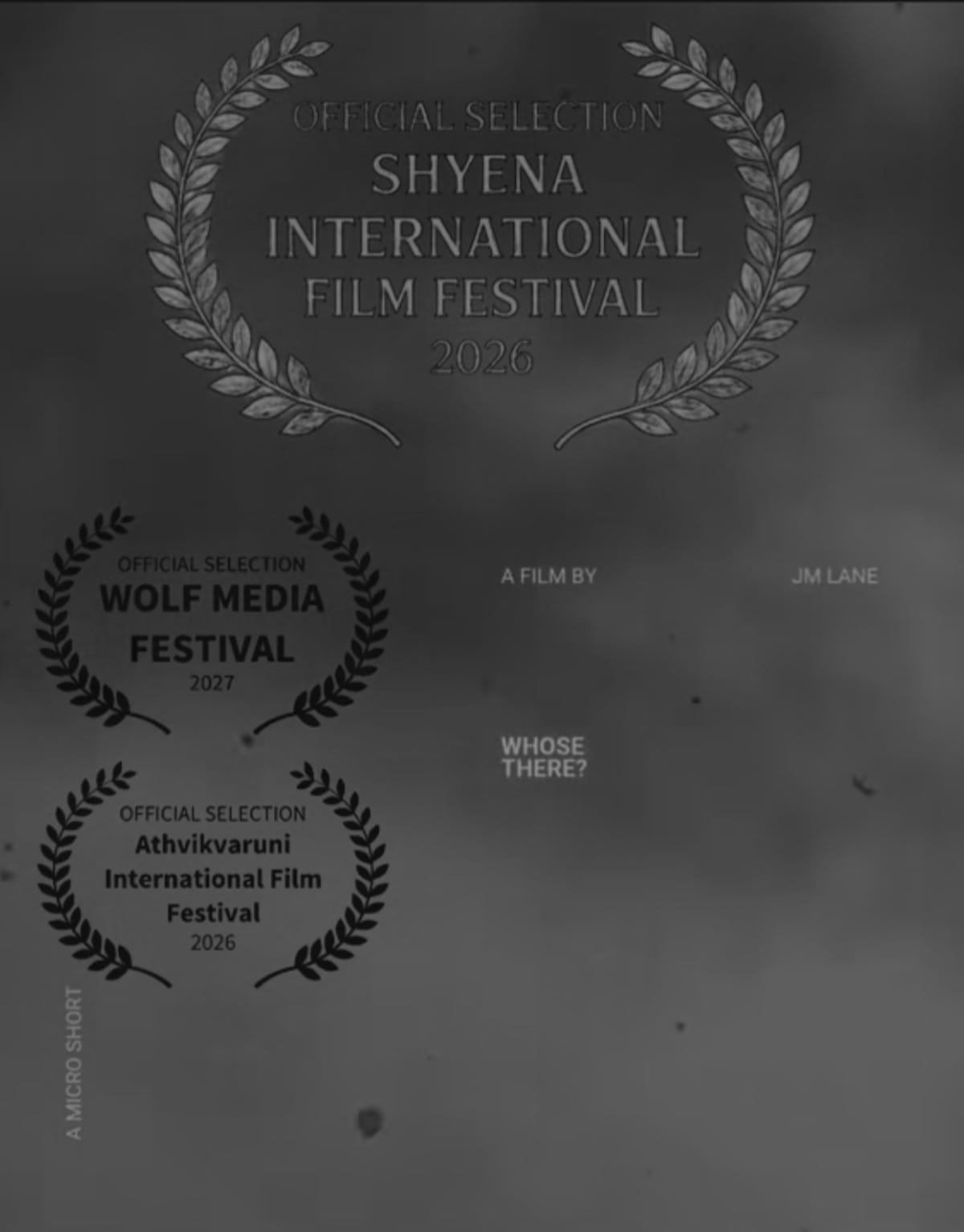
Recently I decided to try telling one through film. Not in any grand way. I had a phone, a tiny space, myself and an idea for a short horror film called Whose There?
That was pretty much the production budget.
There was o crew or fancy camera. Definetly no lighting truck parked outside.l and sadly nobody holding one of those furry microphones above my head.
Just me trying to work out how to make something unsettling with what I already had. And I think that is exactly why I enjoyed it. When I write, I can explain almost anything. If Whose There? I can tell you a man is frightened. I explain to you there is something outside the door. I can write for you in a way that the room feels wrong. With film you have to find another way.
Where is the camera?
What can the viewer see?
What can't they see?
What can they hear?
That last one surprised me, I had to create a soundscape. A scrape outside. Breathing. A knock. Or the sound of nothing at all. Silence can do an awful lot of work if y
It also reminded me how often, as writers, we can continue to explain something long after the reader has already understood it.
Film doesn't give you much room for that. Especially when the whole thing is only a few minutes long. You very quickly discover how irritating it is watching somebody cross a room for ten seconds.
So you cut it.
Get in later.
Get out earlier.
Move on.
I found myself thinking about my writing in exactly the same way afterwards.
Do I need this paragraph?
Can this conversation start three lines later?
Does the reader already know this?
Am I showing them something they have already worked out for themselves?
There was another lesson in it too. We are always waiting for the right tools. I’ll write properly when I get a better laptop. I’ll start editing when I can afford the right software.
I’ll make videos when I buy proper lights.
I’ll try film when I have a decent camera.
There is always another app, another programme, another piece of equipment that seems like it might finally make the work easier.
But most of the time, the thing that matters is starting with what you already have. The phone most of us carry every day can already be a notebook, a word processor, a sound recorder, a camera and, if necessary, an entire tiny film studio.
I
t isn’t going to turn you into Spielberg, but it gives you somewhere to begin.
Mine certainly didn't.
But it lets you try.
And there is something very useful about trying a form of storytelling you aren't completely comfortable with. You become a beginner again and make mistakes. You find stupid solutions to problems you didn't know existed.
You learn.
And then you bring some of that back into the thing you normally do.
Whose There? has since won Best Micro Short Film at the SHYENA International Film Festival in India and has also been submitted to the 25th ISFVF International Student Film and Video Festival at the Beijing Film Academy. Which is still slightly mad to me considering where it started.
A phone.
A small room.
And an idea.
I don't think writers need to become filmmakers, painters, photographers or podcasters. But I do think it is good for us to occasionally tell a story in a way that takes the words away from us. It forces different muscles to work.
And sometimes, when you come back to the page, you see it a little differently.